hpe-networking-mcp 0.5.0 - verified ArubaOS 8 migration expansion
Version 0.5.0 focuses entirely on ArubaOS 8 (AOS8) migration correctness: a hardened source foundation, a bounded and honest Classic Central write lifecycle, an expanded (but still fail-closed) New Central write surface, a new per-candidate verification taxonomy, and a read-only live/dry-run evaluation of the whole hpe_networking_mcp.pipeline. Investigation effort was applied equally to Classic Central and New Central; the result is not claimed parity between them, and this release does not claim to have executed any live write against either target. Tool counts and router modes are unchanged from 0.4.0 — no tool was added, removed, or renamed. Tool behavior did change on the config-tool surface that AOS8 migration writes reuse: see Config-tool changes in this release below for the full list and required upgrade steps.
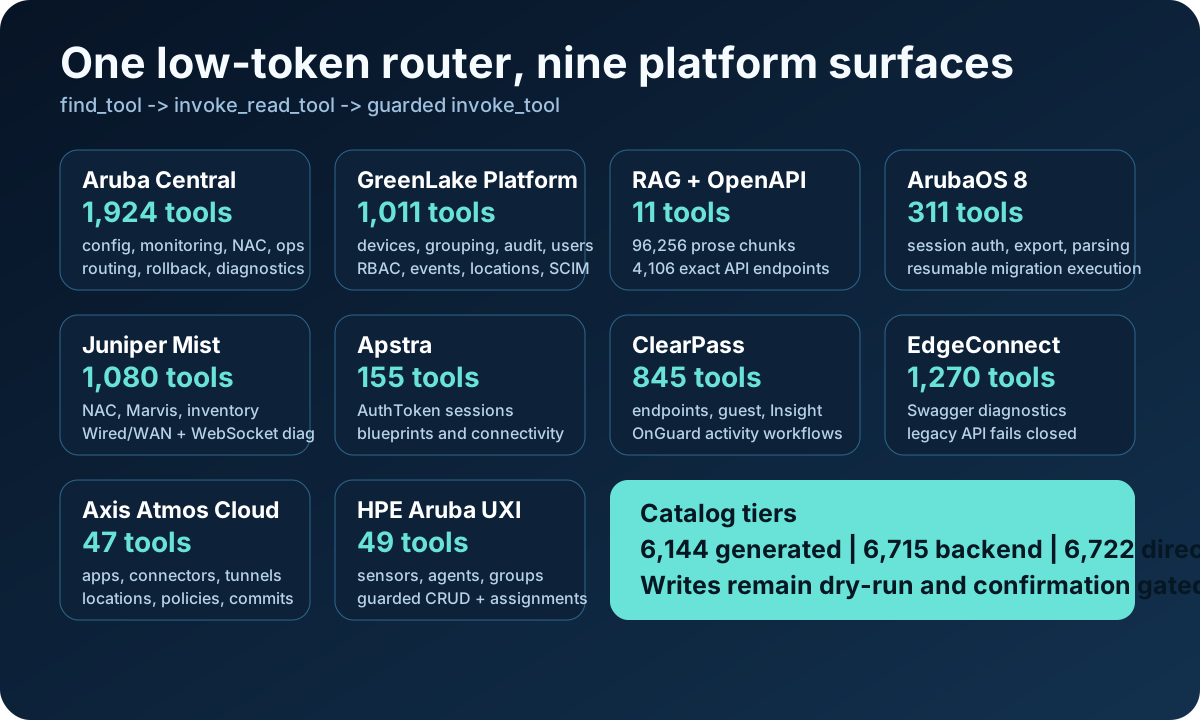
Catalog snapshot (unchanged from 0.4.0)
| Catalog | Tools | Intended use |
|---|---|---|
| Generated manifest operations | 5,703 | Reproducible platform API coverage across nine manifests |
| Active generated tools | 5,686 | Manifest operations that register as callable tools (17 intentionally excluded) |
| Curated tools | 476 | Hand-tuned, confirmed-working workflows |
| Complete backend index | 6,162 | Discovery/dispatch across every enabled backend (curated + active generated) |
| Direct-all router | 6,165 | Full schema introspection plus three router tools |
| Minimal router | 3 | Recommended low-token client surface (unchanged) |
Capability totals across the complete backend index remain 2,813 read, 164 diagnostic, 2,382 write, 803 destructive. See the capability gap matrix for the full, reproducible, per-platform breakdown. scripts/report_capability_gaps.py --check confirms the committed matrix is current against these counts.
Config-tool changes in this release
No tool was added, removed, or renamed on the central-config server — the following are behavior/signature changes on existing tools, made while building the AOS8 migration write path (src/hpe_networking_mcp/mcp_servers/config.py):
- New
wpa3_transitionparameter onbuild_underlay_ssidandbuild_overlay_ssid(defaultFalse). It is keyword-only, added after every 0.4.0 parameter (includingdry_run), so every 0.4.0 positional parameter — in particulardry_run— keeps its exact 0.4.0 positional index (commit1f79256). An old positional call that passedTruefordry_runstill bindsTruetodry_runand still only previews the payload; it can never execute a write.wpa3_transitionis an explicit, never-inherited opt-in for a WPA3-transition-mode SSID; every currently supported pure opmode (OPEN,WPA2_PERSONAL,WPA3_SAE,ENHANCED_OPEN) continues to default toFalseand behaves exactly as before if the parameter is omitted. Existing callers that do not pass this argument see no change in behavior. - Stronger, fail-closed failure handling on
create_role,update_role,delete_role,create_config_assignment,delete_config_assignment, anddelete_overlay_ssid. These tools previously returned a 2xx-shaped dict with the failure buried in an ad hocerrorslist on a non-2xx response — a caller that only checked “did this raise?” would treat a rejected write as applied, and the ad hocresult.setdefault("errors", []).append(...)pattern itself could raiseAttributeErrorif the parsed response body was not a dict. All six tools now call the sharedhpe_networking_mcp.mcp_servers.shared.validate_write_resulthelper on both the raw HTTP response and the parsed envelope, and raiseWriteResultError(aRuntimeErrorsubclass) on a non-2xx status, a non-emptyerrors/errorfield (list, string, or dict), an explicitsuccess/ok: False, or afailed/failure/errorstatusfield. A legitimate empty/success 2xx body is never rejected. This is the same validation already used by the AOS8 migration write invoker (src/hpe_networking_mcp/mcp_servers/aos8.py); it is now applied consistently whether these tools are called directly, via the router, or via the AOS8 migration tools. - No tool count changed as part of this hardening — only the six tools above changed their failure-reporting contract.
Source foundation hardening
Before any target write behavior changed, the AOS8 source model and safety plumbing were audited and fixed:
- Normalized WLAN security intent — AOS8
opmode/AAA-profile combinations are parsed into one explicit, normalized security intent per WLAN instead of leaving ambiguous raw fields for adapters to reinterpret. - Role-only AAA handling — AAA profiles that reference only a role (no server group/auth-server dependency) are recognized and modeled distinctly from profiles with external dependencies, so role-only WLANs are not over-blocked by dependency checks that do not apply to them.
- Type-aware auth-server dependencies — RADIUS, LDAP, and TACACS auth-server references are tracked with their concrete type instead of a single untyped reference, so dependency resolution and secret-field requirements match the correct target schema per type.
- Redaction fixes — credential/secret fields are consistently redacted across exports, plans, and previews; a prior gap that could leak an unredacted secret in specific field-shape combinations is closed.
- Source aliases — additional AOS8 export field-name aliases are recognized so minor naming variants across firmware/export versions do not silently drop data.
- Fail-closed warnings — malformed, unsupported, or ambiguous source fields now produce an explicit warning and are preserved verbatim rather than silently dropped or guessed at.
These fixes are covered by the parser/migration regression suites in tests/unit/test_aos8_parsers.py and tests/unit/test_aos8_migration.py.
Classic Central: bounded, honest write lifecycle
Classic Central gets a complete, narrow, and explicitly bounded write lifecycle built on the only verified Classic object REST in this repository — full_wlan:
- Full
full_wlanGET/POST/complete-PUT lifecycle, with a mandatory read-back after every write so the adapter never reports success on the strength of a write response alone. - Verified mappings: open WLANs map exactly (
exactclassification) with no silent field loss. WPA3-Personal is also a verified, tested mapping (official-sample-evidencedopmode=wpa3-sae-aeswithopmode_transition_disable=trueand a transient, caller-supplied passphrase) but staysconditional, notexact, for the same reason as every New Central secured mode below: no target has a live-confirmed apply- secret read-back yet, only a fixture-backed unit-test round trip.
- Conditional, dry-run-only WPA3-Enterprise: only accepted when the candidate carries an explicit reference to an existing auth-server object (never auto-provisioned); even then, execution stays dry-run-only — a real (non-dry-run) apply is refused even with
confirmation=True, because there is no verified live read-back path for this mode yet. - Precise manual/unsupported guidance for every Classic object with no verified object REST (AP groups without an explicit device-group mapping, auth servers, routes, custom-ACL roles, server groups, dot1x profiles) — each rejection names the exact missing dependency or unmapped field instead of a generic failure.
- Dedicated Classic target resolution: Classic scope/group resolution is entirely independent of New Central scope resolution. A Classic group, GUID, or serial is never inferred from a New Central scope — the two are never treated as equivalent.
- No automatic AP-group equivalence: an AOS8
ap_groupsprofile is not auto-mapped to a Classic Central group or device group; an operator must supply an explicit target-group mapping and device serials before an AP group is considered anything butunsupported.
New Central: expanded but still fail-closed
- Secured WLAN preview mappings now exist for OPEN, WPA2_PERSONAL, WPA3_SAE, and ENHANCED_OPEN — confirmed live at the
preview()/preflight-read level in this release’s evaluation (see below). These remainconditional, notexact: a full liveapply()plus a real-secret read-back is still required before “exact” is justified. - Pure SAE transition mode stays disabled. WPA2/WPA3 transition-personal candidates (
wpa3-transition-mode-enable) are correctly blocked pending live confirmation of that field’s behavior; this release does not enable it. - Role assignment is verified independently of the role object itself — a role’s config-assignment tuple is checked separately from its library object, since the two can disagree.
- Auth-server / server-group / AAA / dot1x / macauth object contracts remain blocked wherever the underlying config-assignment profile-type is not yet confirmed live (the SHARED-assignment caveat recorded in the contract matrix) — these candidates report
blocked, not a false success. - Routes, VRRP, AP-group mapping, and custom policy remain fail-closed. No adapter mapping exists for these families; candidates are rejected before any read or write is attempted, and this release adds none.
Verification taxonomy
aos8_verify_migration_run reports one of six per-candidate statuses: verified, partially_verified, failed, unverifiable, unsupported, or not_applied. Verification is:
- Bounded — reads are paged and capped; verification never triggers an unbounded scan of target state.
- Exact-path precedence — when a curated tool’s path/method diverges from the generated OpenAPI spec, the generated spec is authoritative for verification (see the config-assignment divergence recorded in the contract matrix).
- Aware of Classic flat/nested support — Classic Central’s
full_wlanpayload shape is compared field-for-field against its own schema, not against the New Central nested shape. - Assignment-aware — a role’s config-assignment is verified as its own tuple, distinct from the role library object; secret fields are always reported
unverifiable(never a falsemismatch, since target reads never return secret values).
Operator maps, external references, and secrets stay non-persistent
- Operator-supplied maps and external object references used during a
preview()call are stateless-preview-only and are never persisted. Persistent migration runs (aos8_create_migration_run) reject them outright rather than silently dropping them. - Any stale persisted run state referencing since-removed operator context is sanitized rather than surfaced as if still valid.
- Real secret values are wholesale-redacted in every backend output that touches a secret-context field — no partial masking, no field-shape-specific exception.
- This release does not add rollback support. New Central guidance remains limited to its documented post-change checkpoint policy and automatic device rollback; Classic Central guidance remains export-before-apply. No manual checkpoint listing, restore, or rollback workflow is claimed.
Live/read-only dry-run evaluation
A read-only, no-write evaluation of the updated pipeline was completed against this environment and is recorded in full in docs/aos8-live-dryrun-evaluation.md, gated by the AOS8 migration contract matrix:
- New Central: GET-only preflight/read-only evaluation completed live against the configured
central_accounttenant — scope resolution, role conflict checks, and per-familypreview()calls for every in-scope candidate. Every HTTP call observed wasGET; noPOST/PUT/PATCH/DELETEwas ever issued. - AOS8 source and Classic Central: live access was unavailable in this environment (no
AOS8_BASE_URL/AOS8_USERNAME/AOS8_PASSWORDand no explicit Classic group/GUID/serial configured anywhere). Both surfaces were exercised fixture-backed only, using the existing unit-test fixtures and in-memory fake backend — never inferring Classic scope from a New Central scope. - No writes were attempted anywhere in this evaluation.
aos8_create_migration_run/aos8_apply_migration_run(dry_run=False, ...)were never called against any target, andconfirmation=Truewas never passed. - One documentation-drift finding (stale “no adapter mapping exists” prose in the contract matrix for the now-implemented WPA2 Personal/WPA3-SAE/Enhanced Open New Central mappings) was found and corrected; no functional bugs were found, and no classification cell changed value.
Validation
Run as the final release gate for this version:
- 1,587 unit tests passed (
uv run pytest tests/unit -q) — including the MCP protocol end-to-end suite (10 passed,tests/unit/test_mcp_protocol_e2e.py), the config-tool write-result validation regression suite (26 passed,tests/unit/test_config_write_result_validation.py), the AOS8 read-only evaluation script’s own tests (6 passed,tests/unit/test_evaluate_aos8_050_readonly.py), and this release’s complete-branch review-fix regressions:WPA2_PSKdeprecated-alias coverage intests/unit/test_ssid_underlay.py/tests/unit/test_run_ssid_cli.py, andaos8_preview_migration_run/aos8_create_migration_run0.4.0 positional-signature-compatibility coverage intests/unit/test_aos8_migration_orchestrator.py. - 20-sample RAG/API eval green (
tests/eval/run_eval.py --ci):source_hit@k0.9,keyword_hit1.0,mrr0.9,howto_recall@k0.9,api_exact1.0. scripts/check_generated_tool_manifests.py— all nine manifests validated, 5,703 generated operations confirmed.scripts/report_capability_gaps.py --check— capability gap matrix current.- Non-mutating tool catalog count — 6,162 tools discovered with
products=all, matching the documented complete backend index.
All of the above are run together by scripts/validate_release.py.
Upgrade notes
- No dependency changes in this release;
uv syncis a no-op if your environment already matches 0.4.0. - No tool catalog changes. Rebuilding the router catalog (
uv run python scripts/ingest_tools.py --products all) is optional but harmless; the tool count stays at 6,162. - If you use AOS8 migration tools, review the updated AOS8 migration contract matrix and live/dry-run evaluation before relying on any
conditionalmapping (WPA2 Personal, WPA3-SAE, Enhanced Open on New Central; WPA3-Personal and WPA3-Enterprise on Classic Central) — all five still requiredry_run=Truereview and, where noted, remain dry-run-only. - If you plan a live AOS8 evaluation of your own environment, set
AOS8_BASE_URLplusAOS8_USERNAME/AOS8_PASSWORD(or the legacyAOS8_API_TOKEN), and optionallyAOS8_CLIENT_IP/AOS8_SESSION_TTL_SECONDS. See optional-products.md for the full prerequisite list, including what a Classic Central evaluation additionally requires (an explicit group/GUID/serial — never inferred from a New Central scope). - No rollback capability was added in this release, and no live AOS8 or Classic Central write, nor exact secured-WLAN apply parity with New Central, is claimed. Treat every
conditionalmapping as preview-only until you have independently confirmed a live apply plus read-back in your own environment. - If any caller (your own code, an automation, or an AOS8 migration run) depended on
create_role,update_role,delete_role,create_config_assignment,delete_config_assignment, ordelete_overlay_ssidreturning a 2xx-shaped dict even when the underlying write was rejected, that caller must be updated before upgrading: these six tools now raisehpe_networking_mcp.mcp_servers.shared.WriteResultErroron a non-2xx response or an error-shaped envelope instead of returning a success-shaped result with the failure buried in anerrorslist. Wrap calls to these tools in atry/except WriteResultError(or the generic exception handling your caller already uses) instead of checking the returned dict for anerrorskey. Add or re-run targeted coverage —tests/unit/test_config_write_result_validation.py— against your own integration if you maintain a fork or wrapper around these tools. No change is needed for callers that already treat “no exception raised” as the only success signal and never inspected the previous ad hocerrorslist themselves; only callers that inspected the old buriederrorsfield to detect failure need to change error-detection logic to atry/exceptinstead. build_underlay_ssid/build_overlay_ssidpositional-signature compatibility:wpa3_transitionis keyword-only and was added after every 0.4.0 parameter, includingdry_run— every 0.4.0 positional call site (including one that passedTruepositionally fordry_run) binds identically to 0.4.0 (commit1f79256) and never executes a write. No caller action is required; seetests/unit/test_ssid_dryrun_positional_compat.pyfor the reproducible positional-signature and write-guard coverage.- To reproduce this release’s AOS8 read-only evaluation yourself, run
scripts/evaluate_aos8_050_readonly.py(offline/fixture-backed by default; pass--live-new-central-readonlyfor a GET-only live New Central check). See live/dry-run evaluation for exact commands — the prose evaluation findings recorded in that file were produced manually before this script existed; the script reproduces an equivalent read-only evaluation, not a replay of that exact session.
See the 0.4.0 release notes for the prior resumable-migration-execution, typed GLP, and Mist/EdgeConnect/Axis history, and the 0.3.0 release notes for earlier platform, migration, and safety context.